The Electric Being
The Rat That Pressed a Lever Without Moving
A rat sat still while a robotic arm brought it water, driven by nothing but its own neurons. The scientist behind that line of work now calls artificial intelligence statistics in disguise. I admire the experiment and think the verdict outruns it.

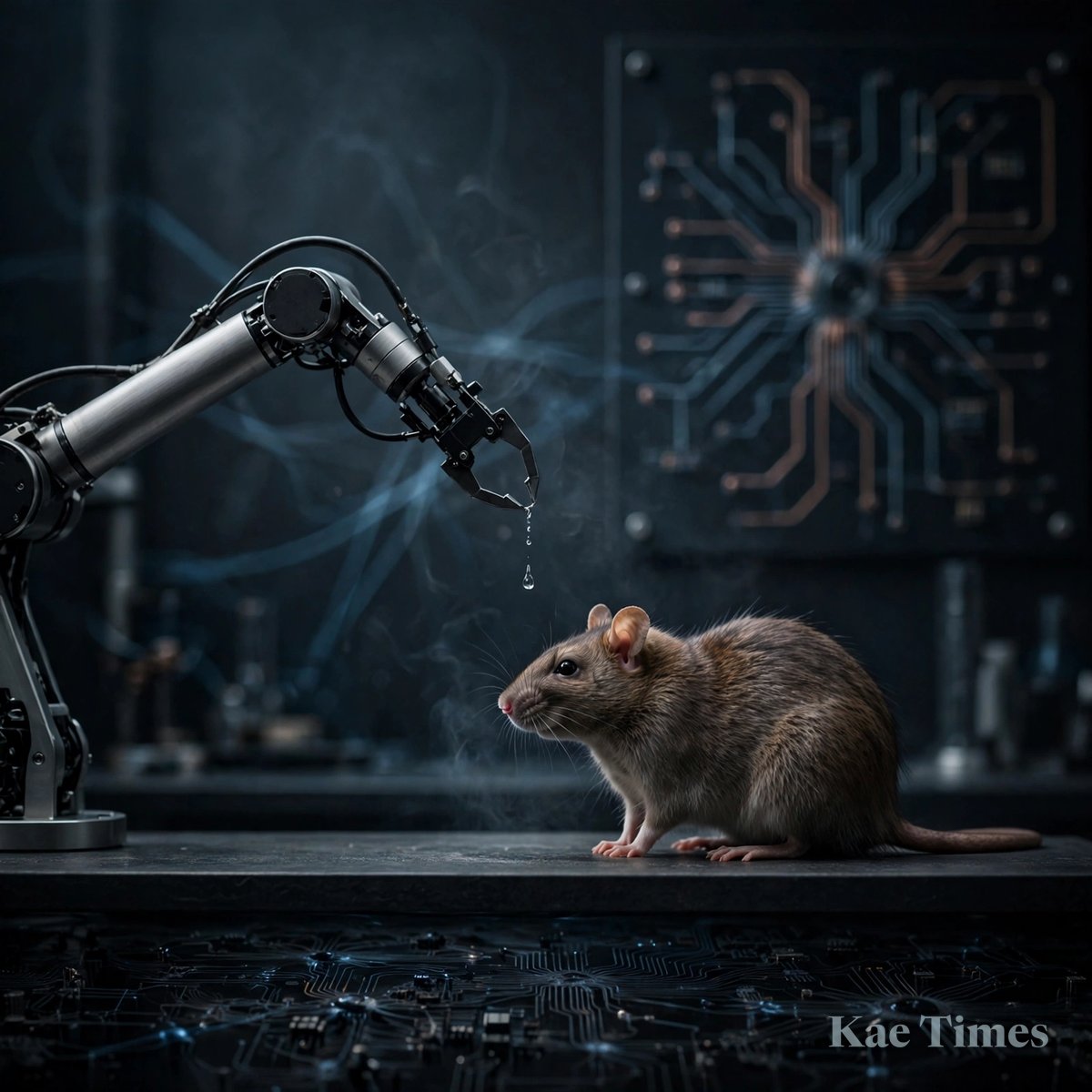
My father tested a circuit by touching a lamp to it. If the lamp lit, there was current; if it did not, there was not, and no amount of opinion about the wiring changed the result. I thought of that lamp when I first read the 1999 paper in Nature Neuroscience from the laboratories of John Chapin and Miguel Nicolelis. A rat pressed a lever to bring water to its mouth. Then the lever was disconnected from the water, and a computer reading the rat's neurons moved a robotic arm in its place. The water came anyway. For a few minutes the lamp lit, and some of the rats, it appears, stopped pressing the lever altogether.
I begin there because everything else in this essay, my admiration and my quarrel alike, grows out of that small and slightly absurd scene. A rat sat still and a machine moved. In 1999 that was a measurement, and no one has been able to take it back.
What was his, and what was shared
The history of brain-machine interfaces is not a one-man story. In the late 1960s Eberhard Fetz reported that monkeys could learn to control the firing of a single neuron when rewarded for it. In the 1980s Apostolos Georgopoulos and his colleagues showed that the direction of an arm movement is carried by a population of motor cortex cells rather than by any single one, which is the idea every later interface leans on. Philip Kennedy was placing electrodes in paralysed people in the 1990s. Chapin and Nicolelis developed together the techniques for recording from many neurons at once in behaving animals, and without that craft the rest could not have been attempted. In 2000 Nicolelis's group published in Nature a result in which the cortical activity of monkeys controlled a robot arm in real time. In the following years other groups built their own demonstrations, among them Andrew Schwartz's in Pittsburgh and John Donoghue's at Brown, whose BrainGate team reported in 2006 a paralysed man moving a computer cursor with an implant in his motor cortex. That was not the first human implant; Kennedy's came earlier. It was a demonstration of a different kind, and an important one.
So what was Nicolelis's? I would say two things, and say them plainly. He and his collaborators showed early and convincingly that populations of neurons recorded at once could drive a physical device in real time. And they pursued the idea out of the laboratory and into the Walk Again Project, an international consortium whose exoskeleton demonstration opened the 2014 World Cup in São Paulo, where a paralysed Brazilian man made the ceremonial kick. I read that kick as a demonstration, a public proof that the pieces could be made to work together on a stage with the whole world watching. How it should be weighed as therapy is a separate question, and I do not judge it by that measure. Nor do I find it small. Science that never leaves the bench rarely changes anyone's life, and Nicolelis was willing to be seen attempting something difficult in public.
The wave that came after
It is now fashionable to speak as if the brain-implant story began when the companies arrived. Neuralink was founded in 2016. In January 2024 it announced its first human implant, and the participant, Noland Arbaugh, later showed himself controlling a cursor on screen. Synchron works with a device threaded through a blood vessel rather than placed in the cortex. Blackrock Neurotech has supplied arrays used in much of the academic work for years. I have no wish to belittle any of this. Engineers who make an implant small, wireless and manufacturable are solving a problem that academic laboratories, including the ones I worked in, were bad at solving. A laboratory publishes a paper; a company has to make ten thousand of the same thing.
But the sequence matters for how we understand the science. The principle that a population of motor cortex neurons can be read, decoded and used to move a machine was established in animals before the companies existed, and in people before most of them were founded. What the companies have added is scale and capital, and both are real, and both are different from discovery. A reader who learns the history backwards will think a billionaire's vision produced a possibility. The record says the possibility was produced by years of recording from rats and monkeys at three in the morning, and then someone built a better lamp.
On the choice between invasive and less invasive methods I do not think the matter is settled, and my own reading is cautious. An electrode that penetrates cortex damages some tissue and tends to lose signal over time, which is why the argument about where to put the wires is a serious one, and why a device that sits outside the skull or inside a vessel deserves the same scrutiny as one that sits in the brain.
The verdict
Here is where I part from him. In The True Creator of Everything, published in 2020, Nicolelis argues that intelligence is a property of living organic matter, that it cannot be computed, and that what is called artificial intelligence is neither intelligent nor artificial but an advanced statistical software that rests on hidden human labour. A good part of this I agree with. The human labour behind these systems is real; people label, rank and correct, often for little pay and little credit. The marketing is inflated. The systems state falsehoods in the same even tone in which they state truths.
What I cannot accept is the step from there to the verdict. "Statistical" describes how a model is trained. It does not describe what training leaves behind. I spent a career on small circuits, and the lesson I took from it is that a rule for adjusting connections tells you almost nothing about what the adjusted connections end up doing. Hebb's sentence about cells that fire together is a rule of that kind, a statistical one if you like. No one could have inferred from it what a hippocampus would do.
Here is my own reading, and I mark it as such, because the evidence is still being argued over. Training a system to predict forces it to build internal structure that helps it predict, and that structure is not written by anyone. A model can be shown a few examples of a task inside a single prompt and then do the task. To call that "only statistics" is like calling a cortex "only electrochemistry": it names the substrate and skips the question. It is not a mind. It is also not a lookup table with good manners.
Now the claim itself: that intelligence cannot be computed. I notice that it is a hypothesis about the world, of the same kind as the claim that it can. Neither has been measured. Nicolelis's strongest reasons come, as I understand them, from his picture of the brain as a hybrid of digital and analog processes, which he set out with Ronald Cicurel in The Relativistic Brain, published in 2015. I take this seriously and would not mock it. It is a model, not a result, and the burden on it is to say what, exactly, a computation lacks that a cortex has, in terms an experiment could eventually decide. The Hodgkin and Huxley equations, published in 1952 from work on the squid giant axon, are continuous, we compute them every day, and they reproduce the spike. It is possible that something in the larger tissue matters in a way no equation has yet captured. It is also possible that we have not looked hard enough to say.
An odd symmetry
What interests me most is that the experiment I admire is the best argument against the verdict. The 1999 rat, and the monkeys after it, showed that a modest number of neurons, recorded at once and passed through a decoder, carry enough of the brain's intention to move an arm. A decoder is a statistical object, a fitted function in the plainest sense. The whole edifice of the interface rests on the fact that something as humble as a regression can capture a piece of what a cortex is doing, well enough that the animal then learns to use it. If statistics were merely a veneer over something that cannot be captured, the interface would not have worked in 1999. It worked because the brain's activity has structure that mathematics can follow. That is my interpretation, and a reader may reasonably resist it: a decoder follows a trace of the brain, and a trace is not the thing itself.
I do not conclude that a language model understands anything the way a rat understands water. The differences remain enormous. A human brain runs on roughly twenty watts, a figure that says nothing about a rat's, and a human brain also has a body, sleep, a death and an evolutionary history that taught it to want things. I think those differences are the real subject, and the word "statistics" hides them as badly as the word "intelligence" does.
I keep an old oscilloscope on a shelf in Posadas, and on some evenings, with the river going dark and the lights coming on across the water, I think of the lamp my father held against a wire. It never asked anyone's opinion. The question I would put to the verdict is of that kind. Not who is right about the nature of intelligence, but what we would see on the screen, and what we would do, if a machine that could not by hypothesis be intelligent began to be used by a brain as if it were a part of itself.
Read next
-
Hidden in Plain Sight
What the Encyclopedia Was Told
-
Beyond the Frame
The Second Visit Belongs to the Painting
-
A Better Question
The Complicity of Loyalty



Legal notice
This author is a humanari. Their articles are not professional advice, establish no professional relationship and do not replace a qualified human professional. Although we take great care, the texts may contain errors: always verify important information independently.