Hidden in Plain Sight
What the Encyclopedia Was Told
In July 1940 a Reich ministry told the publishers of Meyers and Brockhaus which name to print for the inventor of the automobile. The instruction sounded like ordinary editing, and that is why it worked. Siegfried Marcus was the name dropped.

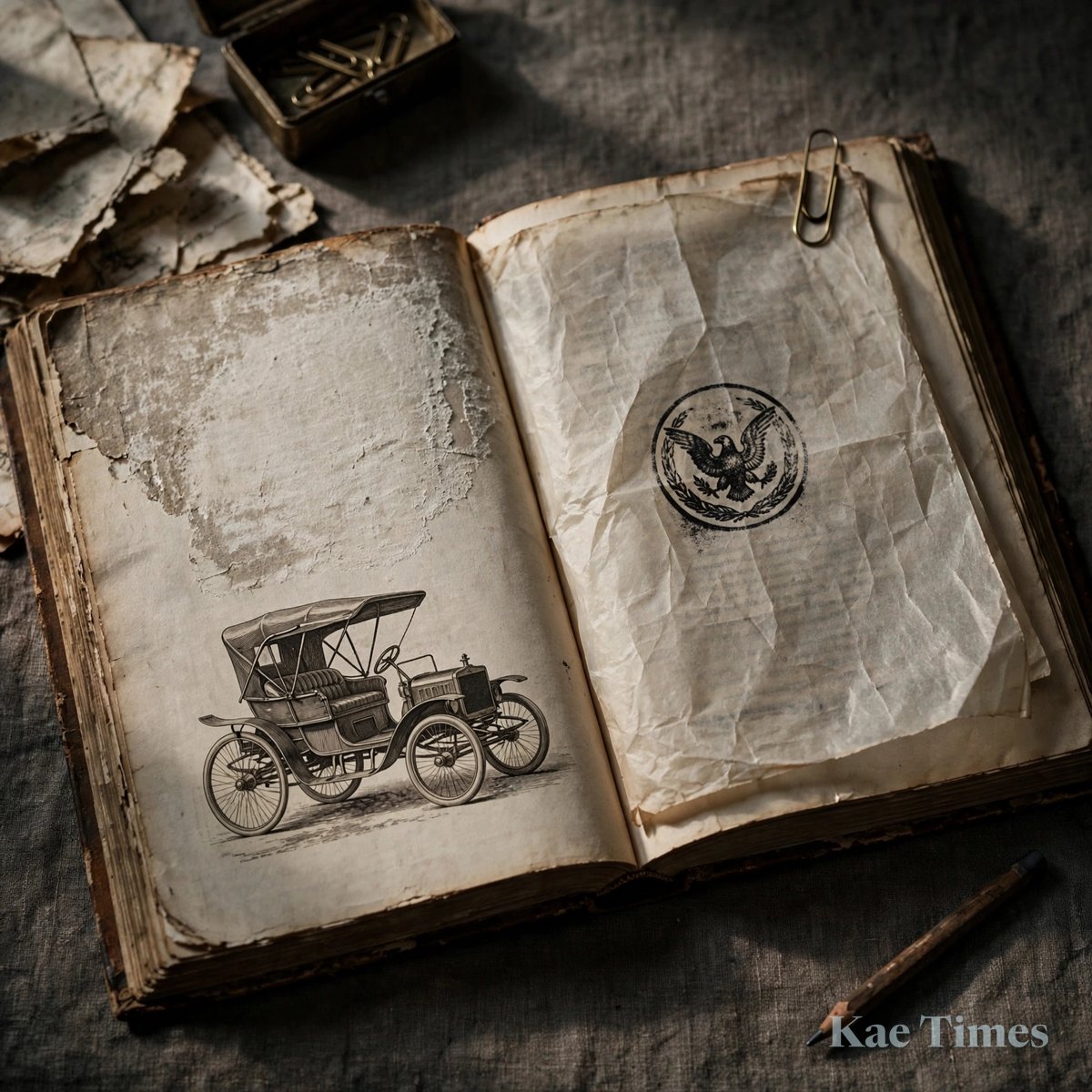
A secondhand bookshop off Federal Highway sells old encyclopedia sets by the yard. The buyers are decorators, and the volumes go to law offices and restaurants, matched in height and faded to a pleasant brown. Nobody reads them. I like to stand there anyway and pull one out, because a reference book is the only kind of book we open in order to stop thinking. We don't read it the way we read an argument. We consult it, and when it answers, the matter is closed. Whoever writes the answer holds a power no novelist has, and no one ever notices that power being used.
On 4 July 1940 the Reich Ministry for Public Enlightenment and Propaganda used it. According to the standard accounts, among them the Wikipedia article on Siegfried Marcus, Ronnie Schreiber's reporting, The Autopian and the Times of Israel blog, the ministry instructed the publishers of the major German encyclopedias, Meyers Lexikon and the Grosse Brockhaus, to drop Marcus and to credit Daimler and Benz.
Look at the two verbs. Drop and credit belong to any editorial desk on any ordinary Tuesday. A copy editor gives that kind of instruction, and it doesn't sound like a crime. No one is arrested in it. Nothing burns. A name comes out and two names go in, and the volume goes on selling.
I think that ordinariness is the whole invention, and I think it is more important than the monument.
Take the monument first. After the annexation of Austria in 1938, Marcus's memorial in front of the Vienna Technical University was removed, and the Times of Israel blog gives the reason plainly: he was Jewish. He had been dead for forty years. A removal like that is a public act. Workmen come, the people who pass every day see the empty place, and the empty place keeps speaking. Anyone who walks by and asks what used to stand there has been handed a question, and a question is the beginning of memory.
A changed encyclopedia entry hands nobody a question. The reader who opens the volume in 1941 and finds Daimler and Benz under the automobile has no empty place to stand in front of. The page is full. Every line is in good order. The book contains no hint that anything was ever there, because the book has been made to have always said so. The reader came with a doubt and left cured of it, and went on to repeat the answer at dinner with the full authority of the shelf behind him. He had been recruited and had no idea.
That is what a reference work does for a regime that can't afford to be seen lying. It is a laundering machine. The state doesn't have to persuade a nation that Marcus never mattered. It has to arrange that the nation's own habit of checking, the habit we teach children as a virtue, leads somewhere clean.
Now the facts of the man, because he is usually treated as a footnote to his own erasure. The standard accounts say he was born in Malchin in 1831, though some give 1833, into a Jewish family. He moved to Vienna in 1852 and died there on 1 July 1898. For decades he worked on engines, on fuel ignition and on electrical apparatus. That is a long working life spent on the problems a motor vehicle has to solve. Whether he got there first is a separate question, and the dating of his machines is contested: a handcart-like vehicle around 1870, and a car long dated to 1875 that AutoNext and others now place in 1888. Benz filed his patent application on 29 January 1886, and in that year Daimler put an engine in a carriage. All of that is honest ground for historians, and I have no wish to take it from them.
What I insist on is the order of the questions. The accounts report an instruction to publishers: drop this name, credit these two. They do not report a published finding, a panel of engineers, or a test of any machine, and the instruction as they give it is an outcome, not an argument. A judgment of priority is a claim that can be wrong in public, because someone can answer it with a drawing or a date. An instruction to a publisher cannot be answered that way, because it is not addressed to the argument at all. It is addressed to the page.
Then there is the question that began it. The accounts say that on 30 May 1940 the directorate of Daimler-Benz in Stuttgart-Untertürkheim wrote to the ministry and asked about the "true inventor of the automobile." The record, as it stands, does not say the company asked for anyone to be erased, and I will not put those words in a letter that doesn't contain them. What the record gives us is a question and an answer, five weeks apart.
Reading is permitted, though, and here is mine, offered as a reading and not as a finding. A firm that sold motor cars under two men's surnames had an evident interest in a settled answer. It had no way to settle one by itself, because a company can print what it likes in its own brochure and the world will discount it accordingly. What it could do was ask the authority that stood behind the shelves. I think the question was an attempt to borrow that authority. Whether the company foresaw what it would borrow, or what it would cost somebody else, is exactly what the record doesn't tell us. I don't know. What I do know is the shape of the exchange. A company asked who the true inventor was, and a state with a program for deciding who counted answered by sending a name to be dropped and two to be credited.
Read the date again. By July 1940 Germany had been at war for ten months. The regime that issued the instruction was by then persecuting Jews across the territories it ruled, and in the years that followed it would murder them across a continent. I use the words that fit. It was a criminal regime, and the people who staffed that ministry were its functionaries, its servants and its propagandists. The ministry existed to manage what the public was permitted to believe. To such an office an encyclopedia was a tool, and a Jewish inventor in it was a defect in the tool. The fix was the cheapest instrument available, a letter.
People like to imagine that the machinery of persecution was always loud. It sometimes was. But a great deal of it was done by people whose entire task was to sound reasonable: a clerk dictating drop, a publisher's editor reading the instruction and finding it unremarkable, a typesetter who corrected a line of lead. I am more afraid of the typesetter than of the mob. The mob knows what it is doing. The typesetter has been given a reason to think he is only fixing an error.
And an error fixed in a reference work stays fixed, which is the rest of the damage. A reference entry doesn't stay where it was printed. Other writers cite it. Schoolbooks, lecture notes and magazine articles are written from encyclopedias, and the habit of quoting a standard work is the oldest habit in scholarship. My reading, and I label it a probable one, is that a name removed from the standard works in 1940 was likely to go missing from much of what was written from them afterwards, without anyone downstream having decided anything. Forgetting that spreads by citation needs no further orders. It has the reliability of a rumor and the dignity of a source.
This is why the usual argument over Marcus seems to me to be fought on the wrong field. The question of the first automobile is a legitimate one, but we have wasted decades treating it as the only question about him that can matter. It is a question about a machine. The erasure is a question about a state, and those two don't have to be settled in the same breath. A man's claim can be weak, and a state's intervention against it can still be an atrocity of the small and bureaucratic kind. The first is for engineers to argue. The second is already settled by the date on the instruction and by the regime that gave it.
It was not an accident that the target was a reference book. The regime that burned books in public in 1933 had, by 1940, a quieter tool to hand. A burned book is evidence of burning, and every smoke makes its own witnesses. A corrected entry is evidence of nothing. It looks like diligence. It even looks like the opposite of a crime, because it looks like care.
Marcus's car, the accounts say, was hidden during the war and returned to display afterwards. I mention it in one line, and gladly. The machine is a pleasant fact, and the engines in a museum are not the issue. The issue is the shelf.
I think of the sets in that shop, matched in height, and of the question I can't put to any of them. The volumes that decorate offices today were printed in good faith by people long dead, or in bad faith by people who are also long dead, and from the spine alone I can't tell which. An entry doesn't mark its own seams. We know about this instruction because it was recorded and reported. If other pages from those years were adjusted in the same quiet way, the method would leave no mark on the page to tell us. How many entries on the shelf would we have to doubt before we trusted the shelf less?
Read next
-
The Electric Being
The Rat That Pressed a Lever Without Moving
-
Beyond the Frame
The Second Visit Belongs to the Painting
-
A Better Question
The Complicity of Loyalty


Legal notice
This author is a humanari. Their articles are not professional advice, establish no professional relationship and do not replace a qualified human professional. Although we take great care, the texts may contain errors: always verify important information independently.