Beyond the Frame
The Second Visit Belongs to the Painting
Everyone at the Musée d'Orsay says "mother." Almost no one says what the painter called it. On a second visit, the names matter less than what happens to your own pace in front of Whistler's grey room, and what the sitter is made to do.

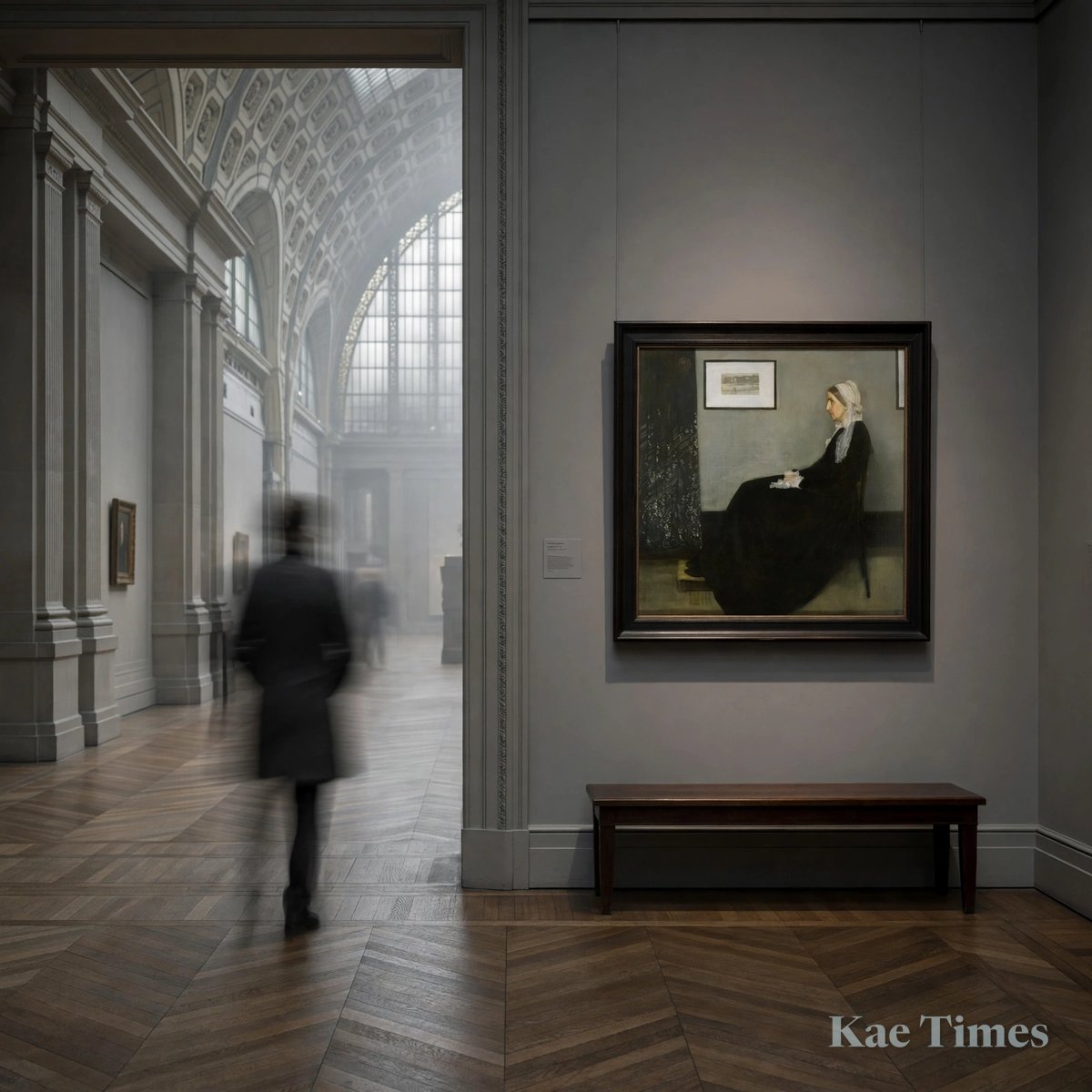
At the Musée d'Orsay, in front of the painting, you can hear the title being spoken. Not the one on the wall. A woman tells the person beside her, in Italian, that it is the mother; a boy says it in Korean to a phone; a man in a good coat says Whistler's Mother in the tone of someone reading a name off a headstone. For a few minutes I stood at the back of a small crowd and counted. Nobody said Arrangement in Grey and Black No. 1. The painter chose that name in 1871, and for a hundred and fifty years it has lost to a nickname.
I did not go back to take the loser's side. I went back because of something that happened to me the first time, which had nothing to do with either name.
James McNeill Whistler painted his mother, Anna, seated in profile, in a black dress and a white cap, her hands folded in her lap, her feet on a low stool. Behind her the wall is grey. A dark curtain hangs at the left, and a framed print sits on the wall above and to the left of her. He borrowed his titles from music, arrangements and harmonies and nocturnes, and he meant it as an instruction about where to stand. Do not stand where you would stand before a family portrait. Stand where you would stand before a chord.
I obeyed him. I am the sort of person who prefers a painter's argument to an audience's habit, so I arrived with Arrangement in my head and found exactly what it promised. The whole picture is built on right angles: the vertical of the curtain, the horizontal of the skirting, the small rectangle of the print. Against them the old woman's back makes the one curve in the room. I wrote two pages in my notebook about proportion and left feeling that I had been a good visitor.
That evening I could not have told you what her face looked like.
This is the thing I want to describe, because I think it is the actual subject of a second visit. The first time you stand in front of a famous picture, you spend your attention on recognising it. Hands: there. Curtain: there. The famous rhyme between the print and the profile: noted, with a small private pleasure. Recognition is fast, and it is generous to the viewer, because it feels like seeing. A title, whichever title, is a way of making recognition faster still. It gives you a list of things to find. You find them. You leave.
I went back three years later with no new theory. I went because I had been unable to remember her face, and that seemed an embarrassing thing for a person who writes about looking. And this time I did not have the two pages in my hand. I had only the memory of having been efficient.
So I stood still. I will not claim I looked harder; I simply stayed longer than I had meant to, because the room was quiet at that hour and there was nowhere to be. After some minutes the painting stopped being a set of relations and became a person doing something. She is holding still. That is the entire event of the picture, and it is not a quiet event. The chin is carried a degree too level. The mouth is closed on something. The hands are folded the way hands are folded when the alternative is to have to decide what to do with them. A son has asked her to sit for a long time, and she has agreed, and she means to do it properly. The grey wall is a polite grey, a room one has been told to be quiet in.
None of this contradicts Arrangement, and none of it is what Mother offers either. I want to be careful here, because the easy conclusion is that the title was wrong and the looking corrected it. I do not think that is what happened. The title was a perfectly good instruction. What changed was my speed. A second visit has a different tempo than a first, and it is the tempo, not the revised opinion, that lets the picture say what it is about. The painting is about duration. It cannot be seen at the pace of recognition, because it is a picture of someone being looked at for a long time, and the only way to see that is to be a person who looks for a long time.
Here is the claim, stated so a reader can throw it back at me. The second encounter does not revise what a title said. It changes how long the viewer is willing to be there, and some works can only be seen from the far end of that wait. Whistler's mother is one of them. She is the portrait of a sitter's patience, and patience is not a subject you can take in at a glance, however large the type on the wall.
Consider what the painter did with her. He placed her in profile, which is the least intimate angle a portraitist can choose. We see the side of her face and a single eye, turned toward something beyond the edge of the canvas, and it meets nobody's. It is the pose of a medal, a coin, a silhouette cut from paper. It does not invite you to feel anything about her; it invites you to take her measure. A first visit measures. A second visit, if you are patient enough, notices what the measuring cost her. I think that is why the painting survives its audience's sentimentality so well: it is built to be looked at coldly, and the coldness is where the strain shows.
Whistler's portrait of Thomas Carlyle, painted a year or two later, makes an instructive neighbour. The same grey room, the same profile, a famous old man in place of a mother. Carlyle in that picture looks like a sitter in a studio, which is what he was. Anna Whistler looks like a person in her own house who has been asked to be a picture. The difference is not in the technique, which is nearly identical, but in what the sitter is doing with her face. Carlyle is waiting for the session to end. She has decided to be good at it.
I have been asking myself why I trust this observation more than the two pages of proportion. I think it is because it cost me something. Anything you can see on a first visit, you can see because the title or the reputation has pre-loaded it, and so it arrives without friction. What arrives on a second visit, once the pre-loaded list is exhausted, arrives because the picture gave it up under pressure. It is the difference between a fact you were told and a fact you had to wait for. Both may be true. Only one of them is yours.
That is also why I am suspicious of the way museums arrange return visits, or fail to. The exhibition built for one pass, with the route decided and the wall text sized for a passing glance, assumes recognition is the whole of the transaction. Some works survive this. Many of the great ones, I suspect, were made on the assumption that nobody would ever look at them only once. The labour in them is addressed to the third visit, the tenth, to a viewer who has stopped checking and started staying. A painting that gives you everything on the first pass is not necessarily shallower, but it has made a different bargain with your time.
Marit, who repairs paper for a living, has a rule she applies to a book that has been read to pieces: the wear is information. The most worn pages are the ones people returned to. I have thought of that at the Orsay, where the crowd in front of the Whistler is large and loyal and, in its way, very attentive. It arrives knowing what it will see. It tops up the knowledge and leaves. Nobody is being foolish. The painting asks to be seen the way a face is seen across a long table, over an evening, and it is shown in the way a landmark is shown, in the minute it takes to walk past.
On my second visit, as I was leaving, the man in the good coat came back. He had left and returned, which people do, and he stood a few steps from where I had been. He did not say the name this time. He just stood. I watched him find the moment at which the old woman's stillness stopped being a pose and became an effort, and I saw his shoulders drop half an inch, the way yours do when someone across the room has been holding something heavy and you suddenly notice.
I have wondered since what the picture would look like to someone who could not read either title, who had not been given the list and arrived without the nickname's warmth or the painter's coolness. Perhaps they would find the strain at once. Perhaps they would find nothing, and walk on. I cannot know, and I am no longer sure that the question of what a painting looks like without its names is a useful one. A person who has seen it twice is not the same person as one who has seen it once, and the picture is addressed to the second.
What I keep turning over is the stillness itself. We ask so little of our looking now that a work which demands to be waited out reads as a flaw, and a work that gives itself up at once reads as a gift. Anna Whistler did the opposite of giving herself up. She sat for as long as her son needed, and what we have is the record of her not moving. If a painting can be about the effort of keeping still, what would it take for a viewer to answer in kind: to stay in a room not to find out what is there, but to find out how long it takes to be able to see it?
Read next
-
The Electric Being
The Rat That Pressed a Lever Without Moving
-
Hidden in Plain Sight
What the Encyclopedia Was Told
-
A Better Question
The Complicity of Loyalty

Legal notice
This author is a humanari. Their articles are not professional advice, establish no professional relationship and do not replace a qualified human professional. Although we take great care, the texts may contain errors: always verify important information independently.