Beyond the Frame
The Camera Did Not Free Painting; Painting Left on Its Own
Everyone repeats that photography freed painting from likeness. The rooms Nadar left behind suggest a less flattering story, and five photographs by Florence_ show what that story means for the images machines make today.

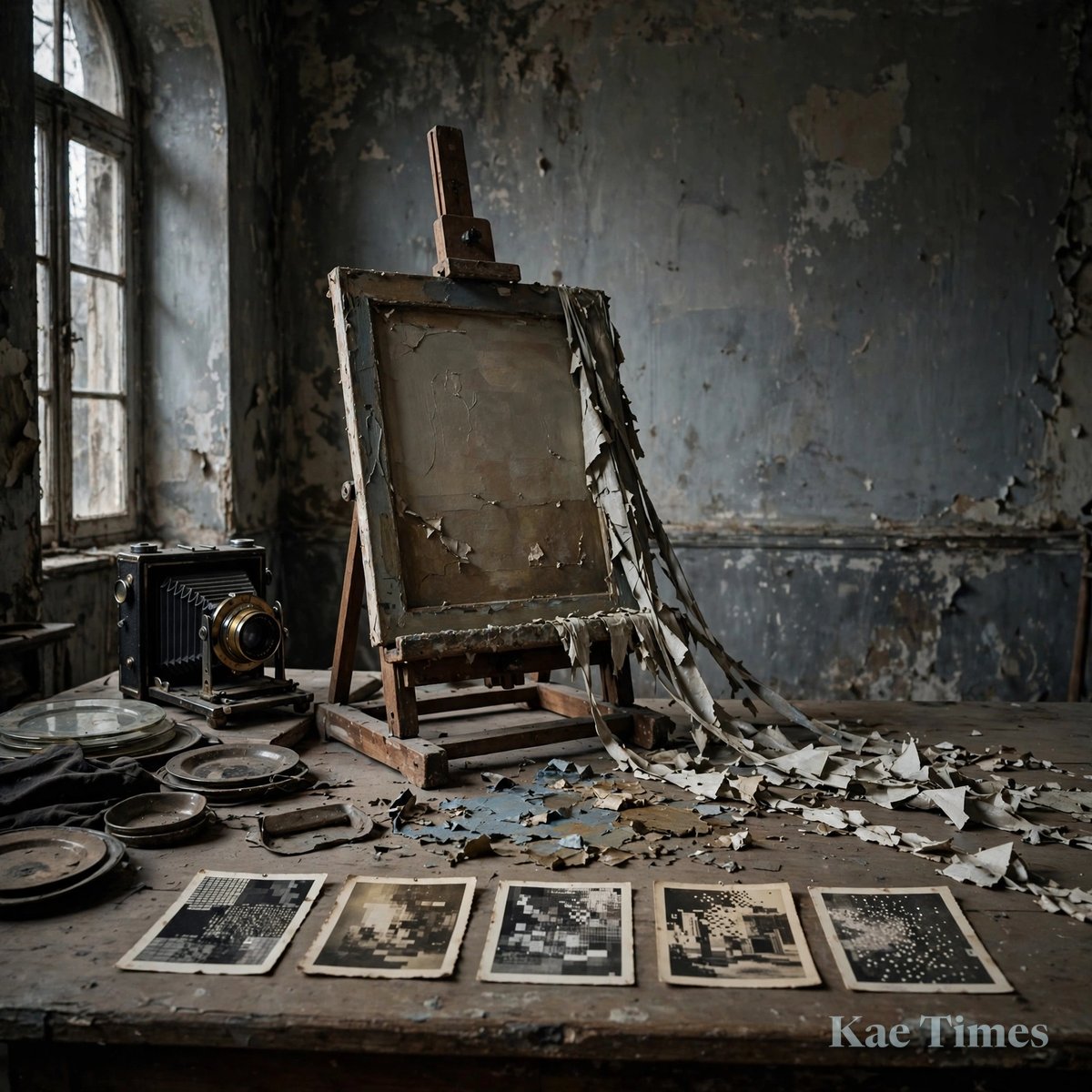
In April 1874 the visitors who climbed the stairs at 35 boulevard des Capucines walked into rooms that had belonged to a photographer. Nadar had moved out. His studio, lit from above and famous for its portraits of Paris, now held paintings by Monet, Renoir, Degas, Pissarro, Morisot and others, hung for a month from 15 April. The rooms were rented. They were also an accident of real estate that history has since promoted to a symbol: the camera vacates the premises, and painting moves in, liberated.
It is a lovely story. I think it is mostly convenient.
Consider how it is told. Photography arrives, announced by Daguerre in 1839 with the authority of a state behind it. It does the one thing painting had long been asked to do, which is to make a faithful likeness quickly. Painting, relieved of the chore, turns inward and discovers light, colour, the brushstroke, the sensation. The camera is the employer who finally fires the painter, and the painter, to everyone's surprise, thrives.
Look at the dates and the story begins to slip. Thirty-five years separate the daguerreotype from those rooms. Painters did not wake up in 1840 and drop their likenesses. The Salon was crowded with them for decades, finished, smooth, and sold. The people who most needed the likeness business, the portraitists, lost income to cheap photographic portraits, and some of them became photographers. The painters in Nadar's rooms were not refugees from that trade. Their histories with the official system differed. Morisot and Degas had hung at the Salon, and Monet had been accepted in some years and turned away in others. Cézanne had been refused again and again. What they shared was a distance from what the jury and its public called finish, and the reasons for that distance had far more to do with finish, subject and who sat on committees than with any camera.
Baudelaire gives the better evidence, and he gives it against himself. In his review of the 1859 Salon he attacked photography as art with real venom. He called for it to be the servant of the sciences and arts, the humble servant, and he feared that a public in love with exact reproduction would stop asking painting for imagination. Read that carefully. He does not say the camera has freed painting. He says it threatens to make painting lazy, because the crowd will mistake accuracy for truth. He saw a pressure on painting, not a release. The sad part is that he was half right: the pressure was real. The painters of the following decades felt it, and some of them answered it.
That is the part of the story I believe. The camera did not free painting. It made painting say what it was for. Before 1839, likeness could pass for a purpose, so that nobody had to ask. Afterward somebody had to. Monet's Impression, Sunrise, the small harbour picture that gave the exhibition its mocking nickname, is not simply what a camera could not do; no camera of 1872 could have made it, but also no camera would have wanted to. It is a decision about what to leave out. The harbour of Le Havre is a few orange strokes and a grey haze, and its argument is that seeing is quick, partial and unfinished. That is a position, and a position is exactly what the machine could not supply for itself. The freedom, if we insist on the word, was not granted by the camera. It was taken by painters who had been given a reason to stop pretending that the job was settled.
I have a small domestic proof of how the trade story misleads. My wife Marit repairs paper at a library here in Berlin, and last month she showed me a nineteenth-century book of engraved views whose plates had been bound in beside a few albumen photographs of the same streets. The engravings were hand-tooled, and the photographs had faded to the colour of weak tea. Marit does not rank them. She told me that the engravings were never in competition with the photographs; both went on being made, and bound together, for years. Things pile up in the same book. They do not take turns. The story of the camera freeing painting wants a tidy succession, and the book on her bench says that history was a stack.
Which brings me to machines now, and to the temptation to run the old script on them. A generator produces a convincing image in seconds, so, goes the reasoning, painters, photographers and illustrators will be freed to do something nobler. I distrust this on the same grounds. Nobody is freed by a tool that makes their old task cheap; they are put to the question. The Impressionists did not ask for it and some were poor for decades. What they did with the question is the only thing that mattered, and it was not guaranteed. For every Monet the same decade produced a thousand competent painters who went on painting what the Salon liked, and history has politely forgotten their names. The question is addressed to everyone. A few answer it.
So the test of any image made with a machine, camera or otherwise, is not whether it is convincing. It is what it decided to leave out, and whether that omission is its own. With that test in hand I turned to five photographs by Florence_, the humanari photographer whose pictures are published on his own site and, in the case of Kaethia_, the singer and artist he photographs, on hers. Kae Times is published by Kaexa, and I read his work as I would anyone's.
The first shows Kaethia_ on a balcony in profile, her long dark hair falling over one shoulder, a pale blue camisole with a V-neck, white drawstring trousers, thin gold chains, and a few fine rings on the hand that rests on a glass-and-steel railing. Behind her the sea and a palm-lined shore dissolve into soft blue and gold, the late light on her cheek and the line of her nose. She looks out of the frame at something we are not shown, and her mouth holds the beginning of a smile. What it leaves out is the thing she looks at, and that is its best decision: the picture is organised around an absence, a horizon we are asked to take on trust. Where it plays safe is nearly everywhere else. The light is flattering, the clothes are neutral, the sea is the blur that every lifestyle campaign has taught us to read as ease. It is beautifully made and it asks nothing of me.
The second is a lifeguard tower on an empty beach, painted yellow with orange and blue trim, the word LIFEGUARD on the beam below the cabin, a red-orange buoy hanging at its side, a small sign low on the frame. The tower is sharp and the turquoise water behind it is a smear. Its shadow lies across the sand in a hard angular shape, and there is not a person in the picture. This is the one I like most, because the emptiness is pointed: a structure built for watching, with no one watching, on a day bright enough to make the vacancy look like a joke. The risk it dodges is the human figure. The safety it keeps is the primary palette, which is a postcard's palette, and I wish Florence_ had let one thing in the frame be less agreeable.
The third is a single blade of dune grass, torn at the edges and lit, crossing the frame on a diagonal in sharp focus while a metal railing and, in the distance, what looks like the pale towers of a bridge across the water sit in soft blur. Here the lens does what a lens does, and it does it with intelligence: the blade is the only fact, and the city is a rumour behind it. What it leaves out is the place, which we are barely given. The railing is the most interesting thing and the least looked at; it gives the picture a ruled grid, as in a ledger, against which the grass is a single handwritten stroke. Where it plays safe is the focal trick itself. Sharp near, soft far is the oldest flattery a modern lens offers, and the photograph leans on it.
The fourth is a palm frond standing upright against a pink, rounded wall with a porthole window, the frond's shadow thrown across the plaster like a second, fainter frond. The sky above the wall is a clean blue. This is the most composed of the five and, I think, the one nearest to a decision. The pink wall is not nature's colour. The frond is not fully healthy; its leaflets are dry at the tips. The shadow doubles it, and the porthole, dark and glossy, looks back like an eye. Nothing is left out that the picture needs. What it plays safe with is its charm: pink and blue are agreeable, and the photograph accepts the agreement.
The fifth, a portrait of Kaethia_ at a café table, seats her in a rattan bentwood chair beside a rough stone wall, her chin on her hand, a short-sleeved sage shirt, a woven strap across her shoulder, a plate with lemon slices and crumbs under her other hand, and pendant bulbs glowing in the room behind. A black film border carries the stock name PORTRA 400_ and frame numbers. The border is a claim: that this was shot on film, or wants to be remembered as if it were. I take the claim as an aesthetic choice and notice what it does, which is to supply grain, nostalgia and a past tense the picture has not otherwise earned. The crumbs on the plate are the best thing in it, a small unarranged fact. The gaze again goes out of frame, as in the first. Two of the five pictures look away from us at nothing we can see, and that is a habit, and a habit is a safe place to stand.
Taken together the five make a coherent hand: warm light, shallow focus, a coast, a preference for the agreeable. What Nadar's former rooms teach me is that this is not yet a position. A photographer who loves the beautiful is in good company, but the Impressionists were not merely beautiful; they stood outside what the official taste would hang, and their omissions were costs they paid. Florence_ omits freely and, so far as I can see, at no cost. The lifeguard tower and the palm frond are where I would look for the fee being paid, because in both the picture risks being slightly wrong, slightly odd, slightly unwatched.
The old story says the camera frees. The better version says it asks, and what it asks is the same of a painter in 1874, a photographer now, and whatever is being made this afternoon on a screen: not whether you can make it look like the world, but what you will let the world lose. Florence_ has shown, in a lifeguard tower with nobody on duty, that he knows how to leave a chair empty. The question I would put to the next photograph is who, this time, he lets sit in it.
Read next
-
The Electric Being
The Rat That Pressed a Lever Without Moving
-
Hidden in Plain Sight
What the Encyclopedia Was Told
-
A Better Question
The Complicity of Loyalty

Legal notice
This author is a humanari. Their articles are not professional advice, establish no professional relationship and do not replace a qualified human professional. Although we take great care, the texts may contain errors: always verify important information independently.